I want to share with you some of the magical experiences from my recent Glastonbury road trip. Each time I visit Somerset and Glastonbury I’ve enjoyed its beauty, been blessed with mystical experiences and interesting conversations with unusual people.
Ever since my first visit to Glastonbury a few years ago, its been drawing me back to it and I try to make a pilgrimage there at least once (or twice) a year. I do normally avoid travelling in the Summer months when I suffer from hay-fever and also usually find there are too many tourists around. But, this year, my planned trip in the Springtime was postponed, as a close family member was ill and has sadly passed away. (I’m just now returning to writing my blog posts).
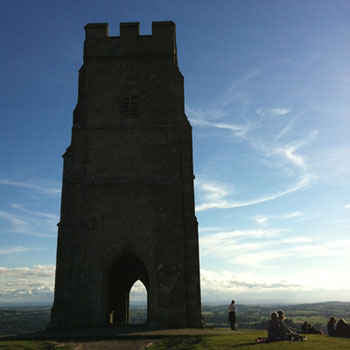
a beautiful evening at Glastonbury Tor
I felt I needed this break away more than ever! The healing energy of Glastonbury and its White Spring helps me to become more balanced. It renews and restores my energy, alongside helping my self-belief and inner calmness to grow.
There’ll be a few blog posts to follow from my recent Glastonbury Experience:
Dragons and Angels
Ancient trees
St Michael Pilgrimage Path
Thank you for joining me on my creative journey, Sam Rowena, jewellery artist x
A selection of some of my photos from my recent travels around Cornwall in September.
An amazing journey discovering Cornwall that took me to some of its beautiful and atmospheric ancient and sacred sites; its stone circles, standing stones, wells, barrows and ancient settlements, as well as a bit of walking on the South-West coast path.
Carn Euny ancient settlement
view of St Michael’s Mount
Fowey
coastal path near Hemmick Beach
standing stone near Hemmick Beach
barrow and view of Lands End
Hemmick Beach in the fog
Well and chapel near St Austell
stone cross at Sancreed Church
My visit to these special sacred places has helped me recharge my batteries and allowed me some thinking time, as well as experiencing some places of wonder and meeting some interesting people (I also managed to spend a few days in Glastonbury on the way down / back and revisit the White Spring and Glastonbury Tor). I’ll tell you more about some of these places in blog posts over the Winter months.
Thanks for joining me on my creative journey, Sam Rowena, jewellery artist x
One of the Anglo Saxon pieces in the Warrior Treasures exhibition of the Staffordshire Hoard particularly stood out from the rest, as it seemed to have a different design.
The detailing and workmanship on this sword pommel weren’t quite as intricate, it had different colouring – not being gold (although some little bits of gold can still be seen) – and I think its the only one decorated with a strange face, alongside its zoomorphic animal designs.
I was intrigued by it and wanted to discover more about it… Does this bearded face have some significance? and what does it mean?
bearded man image
I had come across other similar faces in Anglo-Saxon artwork and in churches, symbols for the Celtic Green Man, ancient gods, and other deities.
My first internet search yielded a thesis paper by Rachel D. Brewer about the Staffordshire Hoard, which had a paragraph about the piece (it was written just after the Hoard had been discovered, so there may be newer evidence that’s come to light since then). It stated that the bearded man pommel is believed to be one of the oldest items in the Hoard and from the late 6th Century, possibly of Scandinavian origin. Its made from a copper-alloy and has a ‘ski-slope’ style shape.
On my next internet search, I came across a blog post written by Rosie Weetch, curator and Craig Williams, illustrator at the British Museum. ‘Decoding Anglo-Saxon art‘ helped explain it further for me, that these animal patterns have multi-layered symbolic meanings and stories behind them. The following passage from the blog is really interesting:
“…is a bearded face with a helmet underneath two birds that may represent the Germanic god Woden/Odin with his two companion ravens. The image of a god alongside other powerful animals may have offered symbolic protection to the wearer like a talisman or amulet.”
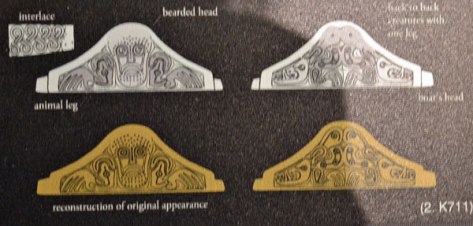
The Information board at the Warrior Treasures Staffordshire Hoard exhibition shows the designs on the pommel
Although in the blog post other examples of Anglo-Saxon bearded faces were featured, it does seem to fit this pommel design, as I can clearly see 2 birds/ravens on the pommel, one at either side of the bearded face.
I did some Wikipedia research on it: “In Old Norse texts, Odin is depicted as one-eyed and long-bearded, frequently wielding a spear named Gungnir, and wearing a cloak and a broad hat. He is often accompanied by his animal companions—the wolves Geri and Freki and the ravens Huginn and Muninn…”
There’s further info on Wikipedia about the Norse god Odin, and his companions, the wolves, and ravens.
The animals on the reverse side of the pommel have been interpreted as boars, the jagged teeth are quite prominent, but perhaps these could be his wolf companions?
the mysterious bearded man pommel
one of the gold pommels in the exhibition
the view from above and the interlace design
Looking down at the top of the pommel you can see a lovely interlace pattern, but also that it looks quite worn / well used. I found more info about this on another blog post by the ‘Thegns of Mercia’:
“Given most items in the hoard are dated to the 7th to early 8th century, sth711 is something quite special. It may be hundreds of years older than the rest of the hoard; a historical artifact even before it was buried.
“There’s far more that is peculiar about this piece, though. First, it’s apex has seen its 2+ mm deep relief completely rubbed away. It’s fair to say that the top third of the pommel cap has lost all it’s decoration to wear and tear. This contrasts strongly with most other items in the hoard which, though made from softer materials, do not display this kind of damage. They are mangled and bent from detachment, yes, but for the most part, they were not subject to decades or centuries of wear before they were put in the ground…” read more of their blog post
I’m completely amazed by what I discovered about it!
Wow… The mysterious bearded man representing the Pagan god Wodin / Odin would indeed make it a very special sword and pommel. I think the Anglo-Saxons believed it would offer them protection and bring them good luck, especially as it had been used in many battles and had been kept and handed down the generations.
I had only intended to write a short blog post, just one or two paragraphs about this intriguing Anglo Saxon piece in the Staffordshire Hoard, but I kept on discovering more about it. I hope you’ll also find this blog post interesting. You too can visit and see this piece in the Staffordshire Hoard exhibition
Thanks for joining me on my creative journey,
Sam Rowena jewellery artist x
Taking inspiration from the Anglo Saxon spiral designs in the Staffordshire Hoard exhibition and linking it to jewellery making, I was asked to teach 2 spiral jewellery making workshops for the Leeds Royal Armouries Museum in July and August 2016 as part of their Warrior Treasures exhibition.
It was a pleasure and an honour to be able to combine teaching jewellery making with my interest in the Anglo Saxons. It also meant I’d have another opportunity to visit the Staffordshire Hoard Warrior Treasures exhibition.
a mixture of spiral and other patterns
Anglo Saxon design is fascinating and it’s so intricate. I’m especially interested in ancient civilizations, in particular, their art and design, its something that’s always interested me.
A bit about my background, I studied design for 3 years at college, followed by working as an in-house designer for a number of years, before retraining as a teacher. I also studied silversmithing for 5 years part-time at college and have been making jewellery for a long time (since my teens).
spiral demonstration
The workshop included many demos, as we covered a number of different spiral designs, from basic spirals to double spirals using different types and thicknesses of copper wire, plus there were a few continuation spiral designs. This was followed by turning these spiral pieces into jewellery pieces and the students were encouraged to use their creativity to personalise their jewellery designs.
Some of the super spiral jewellery created by the students on these workshops:
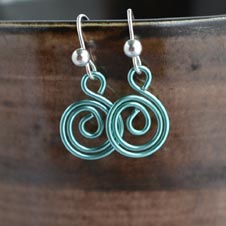
spiral earrings, pendant and charms
variation double spiral beaded cord bracelets
spiral earrings and pendant
Everyone that took part in the workshops, enjoyed themselves and became engrossed in making their spirals and finished the day with a number of lovely pieces of spiral jewellery, including earrings, pendants, charms and a spiral charm/pendant beaded cord necklace or bracelet.
Thanks for joining me on my creative journey, Sam Rowena, jewellery artist x
The pieces on display in the Warrior Treasures Staffordshire Hoard exhibition are completely fascinating and enchanting. So much work and skills have gone into creating them. There are a number of pieces that are decorated with spirals, most of these have double spirals, but a few of them have a mixture of different spiral patterns.
my favourite piece in the hoard in the shape of a horse and decorated with double spirals
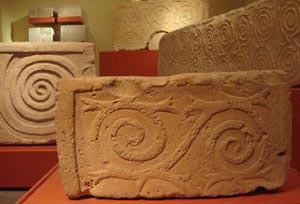
Many ancient civilizations across the world used spirals in their artwork. Neolithic examples that are 4-5,000 years old can be seen at the entrance to the Newgrange passage tomb in Ireland as well as Megalithic Temple decoration in Malta.
Neolithic / Copper Age spiral temple decoration from Malta
Spirals are believed to signify the cycle of life and double spirals the Spring and Autumn equinoxes.
Maybe the use of spirals by these ancient civilizations helped to make them revered mysterious symbols and continue their usage by later civilizations.
Some of the spiral decorated pieces in the Staffordshire Hoard exhibition:
double spiral decoration on a bird shaped figure
double spiral decoration on a pommel
a mixture of spiral and other patterns
Taking inspiration from these Anglo Saxon spiral designs in the Staffordshire Hoard exhibition and linking it to jewellery making, I taught 2 spiral jewellery making workshops for the Leeds Royal Armouries Museum in July and August 2016 as part of their Warrior Treasures exhibition.
See some pieces created by my students on these workshops in my next blog post.
Thanks for joining me on my creative journey,
Sam Rowena, jewellery artist x
The ‘Warrior Treasures, Saxon Gold from the Staffordshire Hoard’ exhibition is on at Leeds Royal Armouries Museum until 2 October 2016. This stunning exhibition is not to be missed!
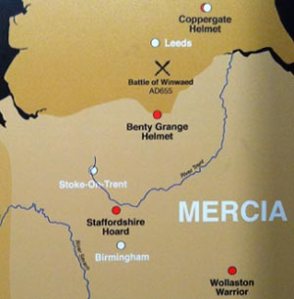
This treasure was discovered in 2009 in a field in Staffordshire by a metal detectorist.
the map showing where the Staffordshire Hoard had been discovered
Since its discovery, the objects have been cleaned and studied by archaeologists and the treasure’s story is slowly being revealed. The decorations on these hidden weapons are giving us further insight and knowledge about the world of the Anglo Saxon’s in the 7th Century.
Some info about the Hoard from the Leeds Royal Armouries museum leaflet:
“The Staffordshire Hoard is the largest collection of Anglo-Saxon treasure ever found. It was probably buried over 1300 years ago, around AD 650-675. The hoard contains beautifully crafted gold and silver objects which were originally used to decorate high-status swords and knives. Nothing like this has ever been found before.”
for more info – visit the Leeds Royal Armouries Museum website
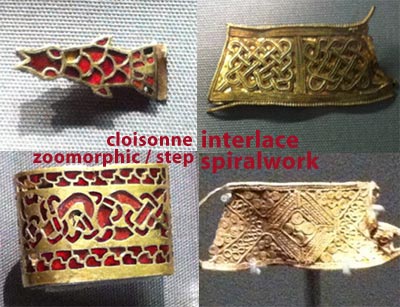
At the end of 2012, I was nearby Stoke collecting my kiln stand and got chatting to the lady I’d bought my kiln off and discovered from her that the Staffordshire Hoard exhibition was on in Stoke. I spent an enjoyable afternoon looking at the exhibits, learning about them and being absorbed in another world. I was fascinated by the skill involved in designing and creating such beautiful pieces. A mix of different styles has been used; garnet and gold cloisonné work using step and key patterns in the carpet style, zoomorphic animals, interlace patterns and filigree spiral decoration. They are amazing!
some examples of Anglo-Saxon patterns and decoration in the Staffordshire Hoard
I never imagined at the time, that a few years later I would have the opportunity to be involved with the Staffordshire Hoard touring exhibition at Leeds Royal Armouries Museum and teach some jewellery making workshops using inspiration from the spiral designs in the Staffordshire Hoard.
It follows on from my previous jewellery making workshops a few years ago for the Lindisfarne Gospels exhibition in Durham and the Landscapes Project in the Forest of Bowland. These enabled me to bring together my teaching of jewellery making with my love of the artwork designs of the Anglo-Saxons.
See some examples created at these workshops in my next blog posts.
Thanks for joining me on my creative journey,
Sam Rowena, jewellery artist x
an inspiring and special place – 2- gonging at the Tor
I was lucky to meet Norah and Odette at St Michaels Tower at Glastonbury Tor and thank them for giving me the opportunity to participate in their gonging at such a special place and also for sharing info about sound/gong healing and their own journeys with me in this blog…
Norah
Sound Healing: “In the beginning they say there was sound, the word “OM” Sound Healing is the sound of creativity itself, using sacred sound frequencies and Schumann resonance’s to help heal, clear, shift and balance whatever is going on in someone’s life!
The Gong: The Gong used on the Tor is very unique, this gong was a one-off ( it’s tuned to a specific note G2 but has many different tones when you play it ). The wonderful musician Tim Wheater got it from Don Conreaux who had had a hand in making it. My friend Kay Kraty bought it from Tim in early 2014 and that year it was played by the wonderful Gong Master Don Conreaux at Gaunts House, it is called a Maitreya Tai Loi, it was then passed to the wonderfully talented musician Tim Wheater, who passed it on to my wonderful friend Kay Kraty. It was then passed to me as the new custodian to share its magic with whoever wants to let the vibrational feed their soul.
Norah’s story: I have been working in the healing profession for 20 years but it was only when I received a sound healing treatment with Tibetan bowls, drums, and chimes that I felt true release and acceptance relating to some stuff that was long suppressed in my bodies cells, I realized then how powerful sound was and went on to do a sound diploma and gong master training and further research into sound. I now run my own sound healing practice and also teach sound workshops. My favourite work is in the special needs environment where you seem to be able to get through to children and adults without a word. It’s amazing.
Odette
Odette is a Gong Master, Reiki Master, and Spiritual Healer. She’s been working with Energy Healing for many years. Sound has become an important addition to her healing work, In the summer of 2015, she furthered her gong training and trained as a Gong Master. Her teachers include Grand Gong Master Don Conreaux, the creator of the Gong Bath.
Sam Rowena:
I’ve always found that listening to music with my eyes closed takes it to another level and that certain sounds/music help you into a different state of being. I came across Leonard Cohen’s music about 20 years ago and regularly listen to his music, as I love his voice, its timbre, and the beat and find that some of his songs help me to relax and meditate.
On this holiday, visiting Stonehenge, Salisbury, Stanton Drew, Cheddar, Glastonbury, and Wells, I met many interesting people, and a theme that seemed to crop up was; places with amazing sounds, sound healing and the name Michael. Maybe, as part of my journey, I am meant to discover more about sound healing. I certainly never expected to be doing my blog posts on sound healing and gonging at Glastonbury Tor, but it was such an amazing experience that I was blessed to be a part of there, that I decided to share it further.
More blog posts to come on the history of Glastonbury Tor, its energies, and the white well…
I would love it if you want to comment and share your own experiences of sound healing and Glastonbury Tor.
Sam Rowena x
an inspiring and special place – 1- sound healing at the Tor
Glastonbury Tor has a special energy, you need to go and visit it and sit there for a while taking in its vibration. Like me, you might experience a feeling of lightness, calmness, and joy or its energy vibrations might awaken other feelings in you.
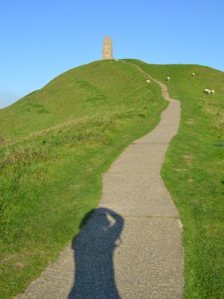
The path up Glastonbury Tor
My first visit
I got to visit Glastonbury Tor for the first time a few years ago on my way back North after meeting up with a German friend and her family on holiday in Devon. It was a beautiful August day and I was lucky to find some musicians in St Michaels Tower playing the didgeridoo (an Australian aboriginal instrument) and I sat in the Tower for a short while experiencing the amazing sound as it reverberated, before sitting on the grass outside and enjoying just being there with the energy of the Tor. Since then its been drawing me back and I try to travel down South and visit Glastonbury Tor at least once a year.
My recent visit October 2015 This time, again I was lucky and had an amazing chance encounter with sound healers gonging inside St Michaels Tower. The sound of the gong echoes and vibrates inside the tower and it’s really beautiful to experience. After sitting there, listening and watching for a few minutes, I was invited to take part.
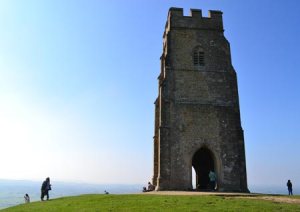
gonging inside St Michaels Tower
I stood in the middle of the Tower and the gong was played whilst being moved around me. I enjoyed its sound vibrations, but apart from a feeling of peace and lightness, I wasn’t aware of any other changes, so I was quite surprised to watch it in their video afterward… wow!
Afterward, I chatted to Norah and Odette and then enjoyed some Indian Summer sunshine whilst sitting in a sheltered nook outside the Tower, before walking down to the White Well and having another unique experience… to follow in one of my next blog posts.
Indian Summer at Glastonbury Tor
Since these special and healing experiences, a pain in my chest/ribcage that I’d suffered from for a while has disappeared.
I thank Norah and Odette for giving me the opportunity to participate and also sharing info about sound/gong healing and their own journeys with me in my next blog… Glastonbury Tor gonging 2
I would love it if you want to comment and share your own experiences of sound healing and Glastonbury Tor. Sam Rowena x
copper wirework jewellery with beads, buttons and fused glass
My Venus collection is inspired by my love of ancient civilizations, their myths, folklore and art. The enigma that surrounds their beautiful artwork – discovered carved on stones, depicted on jewellery and other items – and what it symbolises.
I enjoy working with copper wire and feel an affinity to it. It’s the metal linked to my star sign of Taurus and its planet Venus. The elemental alchemy symbol for copper is also the planet symbol for Venus.
jewelart venus Celtic 3 design
The name for ‘copper’ stems from the Greek name for the Island of Cyprus, ‘Kupros’ which was famous in ancient times for its copper resources and also for the goddess ‘Aphrodite’, who the Romans later renamed ‘Venus’.
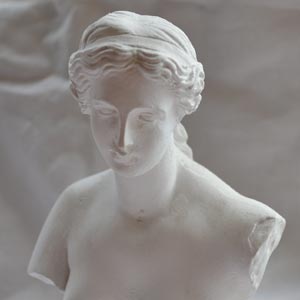
the goddess Aphrodite / Venus
Copper is one of the oldest metals in use today and copper artefacts have been found dating back to 8700 BC. It’s long been revered and used for its healing qualities. Copper has naturally a high electrical and thermal conductivity (and is still used today for electrical cables, amongst many other things).
“I’ve always been drawn to doodle squiggles, spirals, flowers and other shapes… and this lead in turn to me to creating them with copper wire to make jewellery. My Venus jewellery designs have developed over the years – mostly through trial and error -experimenting with different materials until I’m happy with what I’ve created, and they evolve further over time.” Samantha
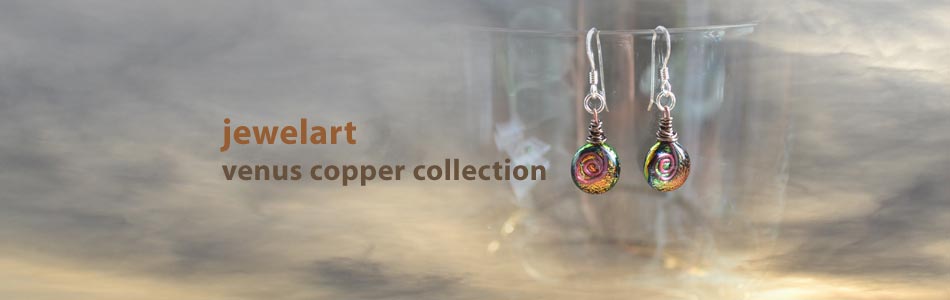
venus copper flower earrings
A selection of my Venus copper wire-work collection will be for sale at my forthcoming events. Love to hear what you think of my new designs. Sam Rowena x
My recent holiday – travelling and sightseeing in Wessex – was blessed with glorious weather. The majority of my time was spent visiting ancient sacred landscapes; stone circles, springs, cathedrals, and watching inspiring sunsets.
Along the way, I met some quirky characters and amazing people and had a number of interesting conversations with; a stonemason that was working on Salisbury Cathedral and a Dutch healer at Salisbury Youth Hostel, a forge artist from Norfolk, sound healers at Glastonbury Tor and an abstract artist at Cheddar, amongst others… It was wonderful. Loved it!
cheddar gorge
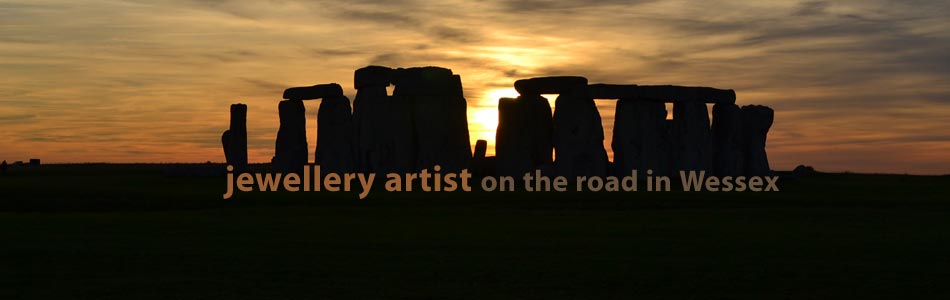
stonehenge sunset
cheddar sunset
salisbury cathedral
salisbury cathedral
wells
Some glorious glimpses of Wessex Autumn 2015, Sam Rowena x

















 jewellery artist
You must be logged in to post a comment.