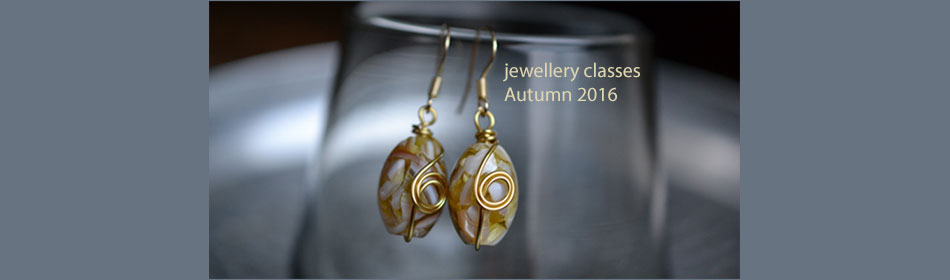
Some of the fab jewellery created by my students on my last jewellery making classes of 2016. There’s always such a great creative vibe at the classes with everyone choosing their own beads and later on in the class, choosing designs to work on.
Everyone in the classes makes something different, unique and personalised.
A selection of some of my photos from my recent travels around Cornwall in September.
An amazing journey discovering Cornwall that took me to some of its beautiful and atmospheric ancient and sacred sites; its stone circles, standing stones, wells, barrows and ancient settlements, as well as a bit of walking on the South-West coast path.
standing stone near Hemmick Beach
Hemmick Beach in the fog
stone cross at Sancreed Church
Carn Euny ancient settlement
view of St Michael’s Mount
coastal path near Hemmick Beach
Fowey
barrow and view of Lands End
Well and chapel near St Austell
My visit to these special sacred places has helped me recharge my batteries and allowed me some thinking time, as well as experiencing some places of wonder and meeting some interesting people (I also managed to spend a few days in Glastonbury on the way down / back and revisit the White Spring and Glastonbury Tor). I’ll tell you more about some of these places in blog posts over the Winter months.
Thanks for joining me on my creative journey, Sam Rowena, jewellery artist x
One of the Anglo Saxon pieces in the Warrior Treasures exhibition of the Staffordshire Hoard particularly stood out from the rest, as it seemed to have a different design.
The detailing and workmanship on this sword pommel weren’t quite as intricate, it had different colouring – not being gold (although some little bits of gold can still be seen) – and I think its the only one decorated with a strange face, alongside its zoomorphic animal designs.
I was intrigued by it and wanted to discover more about it… Does this bearded face have some significance? and what does it mean?
bearded man image
I had come across other similar faces in Anglo-Saxon artwork and in churches, symbols for the Celtic Green Man, ancient gods, and other deities.
My first internet search yielded a thesis paper by Rachel D. Brewer about the Staffordshire Hoard, which had a paragraph about the piece (it was written just after the Hoard had been discovered, so there may be newer evidence that’s come to light since then). It stated that the bearded man pommel is believed to be one of the oldest items in the Hoard and from the late 6th Century, possibly of Scandinavian origin. Its made from a copper-alloy and has a ‘ski-slope’ style shape.
On my next internet search, I came across a blog post written by Rosie Weetch, curator and Craig Williams, illustrator at the British Museum. ‘Decoding Anglo-Saxon art‘ helped explain it further for me, that these animal patterns have multi-layered symbolic meanings and stories behind them. The following passage from the blog is really interesting:
“…is a bearded face with a helmet underneath two birds that may represent the Germanic god Woden/Odin with his two companion ravens. The image of a god alongside other powerful animals may have offered symbolic protection to the wearer like a talisman or amulet.”
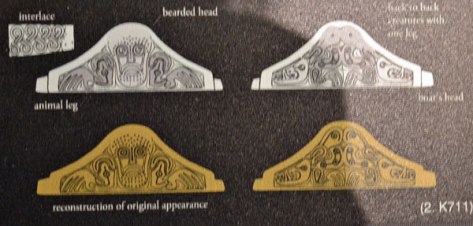
The Information board at the Warrior Treasures Staffordshire Hoard exhibition shows the designs on the pommel
Although in the blog post other examples of Anglo-Saxon bearded faces were featured, it does seem to fit this pommel design, as I can clearly see 2 birds/ravens on the pommel, one at either side of the bearded face.
I did some Wikipedia research on it: “In Old Norse texts, Odin is depicted as one-eyed and long-bearded, frequently wielding a spear named Gungnir, and wearing a cloak and a broad hat. He is often accompanied by his animal companions—the wolves Geri and Freki and the ravens Huginn and Muninn…”
There’s further info on Wikipedia about the Norse god Odin, and his companions, the wolves, and ravens.
The animals on the reverse side of the pommel have been interpreted as boars, the jagged teeth are quite prominent, but perhaps these could be his wolf companions?
one of the gold pommels in the exhibition
the mysterious bearded man pommel
the view from above and the interlace design
Looking down at the top of the pommel you can see a lovely interlace pattern, but also that it looks quite worn / well used. I found more info about this on another blog post by the ‘Thegns of Mercia’:
“Given most items in the hoard are dated to the 7th to early 8th century, sth711 is something quite special. It may be hundreds of years older than the rest of the hoard; a historical artifact even before it was buried.
“There’s far more that is peculiar about this piece, though. First, it’s apex has seen its 2+ mm deep relief completely rubbed away. It’s fair to say that the top third of the pommel cap has lost all it’s decoration to wear and tear. This contrasts strongly with most other items in the hoard which, though made from softer materials, do not display this kind of damage. They are mangled and bent from detachment, yes, but for the most part, they were not subject to decades or centuries of wear before they were put in the ground…” read more of their blog post
I’m completely amazed by what I discovered about it!
Wow… The mysterious bearded man representing the Pagan god Wodin / Odin would indeed make it a very special sword and pommel. I think the Anglo-Saxons believed it would offer them protection and bring them good luck, especially as it had been used in many battles and had been kept and handed down the generations.
I had only intended to write a short blog post, just one or two paragraphs about this intriguing Anglo Saxon piece in the Staffordshire Hoard, but I kept on discovering more about it. I hope you’ll also find this blog post interesting. You too can visit and see this piece in the Staffordshire Hoard exhibition
Thanks for joining me on my creative journey,
Sam Rowena jewellery artist x
Taking inspiration from the Anglo Saxon spiral designs in the Staffordshire Hoard exhibition and linking it to jewellery making, I was asked to teach 2 spiral jewellery making workshops for the Leeds Royal Armouries Museum in July and August 2016 as part of their Warrior Treasures exhibition.
It was a pleasure and an honour to be able to combine teaching jewellery making with my interest in the Anglo Saxons. It also meant I’d have another opportunity to visit the Staffordshire Hoard Warrior Treasures exhibition.
a mixture of spiral and other patterns
Anglo Saxon design is fascinating and it’s so intricate. I’m especially interested in ancient civilizations, in particular, their art and design, its something that’s always interested me.
A bit about my background, I studied design for 3 years at college, followed by working as an in-house designer for a number of years, before retraining as a teacher. I also studied silversmithing for 5 years part-time at college and have been making jewellery for a long time (since my teens).
spiral demonstration
The workshop included many demos, as we covered a number of different spiral designs, from basic spirals to double spirals using different types and thicknesses of copper wire, plus there were a few continuation spiral designs. This was followed by turning these spiral pieces into jewellery pieces and the students were encouraged to use their creativity to personalise their jewellery designs.
Some of the super spiral jewellery created by the students on these workshops:
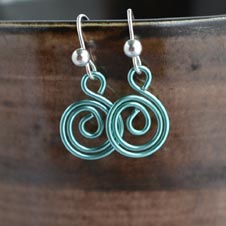
spiral earrings, pendant and charms
variation double spiral beaded cord bracelets
spiral earrings and pendant
Everyone that took part in the workshops, enjoyed themselves and became engrossed in making their spirals and finished the day with a number of lovely pieces of spiral jewellery, including earrings, pendants, charms and a spiral charm/pendant beaded cord necklace or bracelet.
Thanks for joining me on my creative journey, Sam Rowena, jewellery artist x
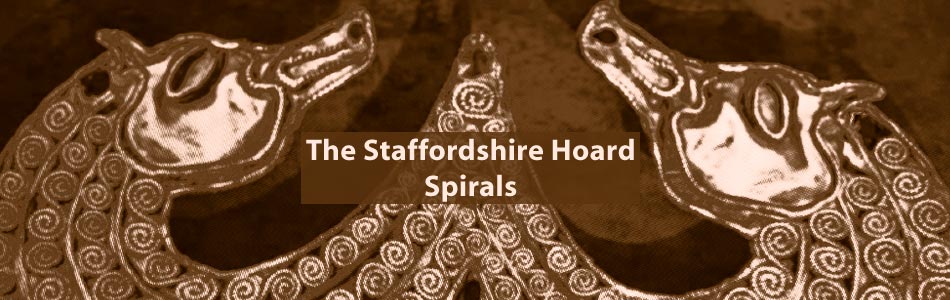
The pieces on display in the Warrior Treasures Staffordshire Hoard exhibition are completely fascinating and enchanting. So much work and skills have gone into creating them. There are a number of pieces that are decorated with spirals, most of these have double spirals, but a few of them have a mixture of different spiral patterns.
my favourite piece in the hoard in the shape of a horse and decorated with double spirals
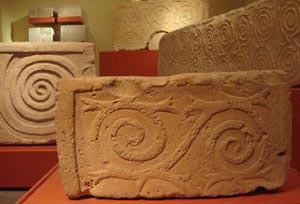
Many ancient civilizations across the world used spirals in their artwork. Neolithic examples that are 4-5,000 years old can be seen at the entrance to the Newgrange passage tomb in Ireland as well as Megalithic Temple decoration in Malta.
Neolithic / Copper Age spiral temple decoration from Malta
Spirals are believed to signify the cycle of life and double spirals the Spring and Autumn equinoxes.
Maybe the use of spirals by these ancient civilizations helped to make them revered mysterious symbols and continue their usage by later civilizations.
Some of the spiral decorated pieces in the Staffordshire Hoard exhibition:
double spiral decoration on a bird shaped figure
double spiral decoration on a pommel
a mixture of spiral and other patterns
Taking inspiration from these Anglo Saxon spiral designs in the Staffordshire Hoard exhibition and linking it to jewellery making, I taught 2 spiral jewellery making workshops for the Leeds Royal Armouries Museum in July and August 2016 as part of their Warrior Treasures exhibition.
See some pieces created by my students on these workshops in my next blog post.
Thanks for joining me on my creative journey,
Sam Rowena, jewellery artist x
The ‘Warrior Treasures, Saxon Gold from the Staffordshire Hoard’ exhibition is on at Leeds Royal Armouries Museum until 2 October 2016. This stunning exhibition is not to be missed!
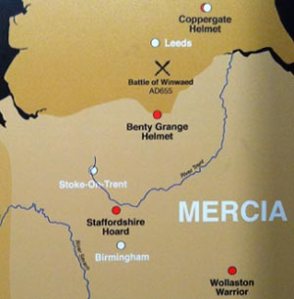
This treasure was discovered in 2009 in a field in Staffordshire by a metal detectorist.
the map showing where the Staffordshire Hoard had been discovered
Since its discovery, the objects have been cleaned and studied by archaeologists and the treasure’s story is slowly being revealed. The decorations on these hidden weapons are giving us further insight and knowledge about the world of the Anglo Saxon’s in the 7th Century.
Some info about the Hoard from the Leeds Royal Armouries museum leaflet:
“The Staffordshire Hoard is the largest collection of Anglo-Saxon treasure ever found. It was probably buried over 1300 years ago, around AD 650-675. The hoard contains beautifully crafted gold and silver objects which were originally used to decorate high-status swords and knives. Nothing like this has ever been found before.”
for more info – visit the Leeds Royal Armouries Museum website
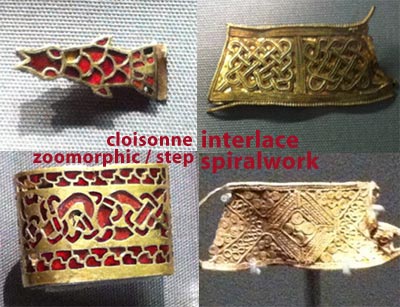
At the end of 2012, I was nearby Stoke collecting my kiln stand and got chatting to the lady I’d bought my kiln off and discovered from her that the Staffordshire Hoard exhibition was on in Stoke. I spent an enjoyable afternoon looking at the exhibits, learning about them and being absorbed in another world. I was fascinated by the skill involved in designing and creating such beautiful pieces. A mix of different styles has been used; garnet and gold cloisonné work using step and key patterns in the carpet style, zoomorphic animals, interlace patterns and filigree spiral decoration. They are amazing!
some examples of Anglo-Saxon patterns and decoration in the Staffordshire Hoard
I never imagined at the time, that a few years later I would have the opportunity to be involved with the Staffordshire Hoard touring exhibition at Leeds Royal Armouries Museum and teach some jewellery making workshops using inspiration from the spiral designs in the Staffordshire Hoard.
It follows on from my previous jewellery making workshops a few years ago for the Lindisfarne Gospels exhibition in Durham and the Landscapes Project in the Forest of Bowland. These enabled me to bring together my teaching of jewellery making with my love of the artwork designs of the Anglo-Saxons.
See some examples created at these workshops in my next blog posts.
Thanks for joining me on my creative journey,
Sam Rowena, jewellery artist x
On my recent trip to Yorkshire to take part in the Thirsk Art in the Pen, I stayed nearby in the pretty medieval town of Helmsley and managed to take a lovely walkabout on a beautiful evening.
Some info about Helmsley Castle from my English Heritage guidebook:
“The castle is surrounded by spectacular banks and ditches, this great medieval castle’s impressive ruins stand beside the attractive market town of Helmsley, in the North Yorkshire Moorland National Park.
Helmsley Castle
The fortress was begun around 1120 by Walter Espec, the Norman baron who also founded nearby Rievaulx Abbey and Kirkham Priory. Most of Hemsley’s surviving stonework defences were raised during the late 12th and 13th Centuries by the crusader Robert de Roos and his descendants. This medieval fortress’s first and last military trial came during the Civil War. Held for King Charles, it endured a 3-month siege before being starved into submission in November 1644 by Parliamentarians under Sir Thomas Fairfax. Fairfax then dismantled the defences, but spared the mansion, subsequently the home of his daughter and her husband, the Duke of Buckingham. It was demoted to a romantic backdrop when later owners moved to nearby Duncombe Park.”
beautiful gardens next to the castle
the medieval back view of Helmsley
These photos were taken with my phone, which unfortunately isn’t brilliant at taking photos, so it looked even better in real life!
Helmsley is not just picturesque, it was crowned Britain’s best market town high street in 2015. Plus there are lots to do in the surrounding areas, Rievaulx and Byland Abbeys are both nearby, and can both be visited on foot from Helmsley via the Cleveland Way National Trail, approx 1.5 hours each way.
Travelling east from Helmsley its 14 miles to Thirsk and going west its 30 miles to Scarborough.
Jewelart in one of the cattle pens at the first Art in the Pen at Thirsk, Yorkshire, where over 100 cattle pens were transformed into amazing pop-up mini-galleries.
Some of the ‘pens’ are stunning, gorgeous arts and crafts displayed beautifully. Many ingenious ways of displaying work are used in each space, making each one a unique pop-up gallery.
Thankfully, a friend’s partner came over to look after my pen and I had an opportunity to take a wander around – say hello to people I knew – and enjoy looking at the other pens and see how some of the other artists and designer-makers had displayed their work.
Some of the pens looked so professionally displayed, plus the work was of such high caliber, that I couldn’t help feeling a bit of ‘stall envy’. It’s only my 2nd year of taking part in the Art in the Pen and I think my pen display has improved. I’ve upgraded from white bedsheets covering the inside of the pen to a thicker woolen material which drapes better, although next time I’ll buy something specifically for it – in one colour – that’s long enough to cover it all. Overall, my display could also do with some tinkering, maybe it needs a bit extra sparkle…
To create some of my jewelart abstract glass pendants, I use glue to attach a bail onto the glass and I have to admit that gluing is one of my least favourite tasks, here are some of my adventures learning how best to use it.
You would think that gluing a bail onto a glass cabochon would be a piece of cake. But there is more to it than you think, for a start, you can’t just use any old glue…
Glass has got a smooth and cold surface and not all types of glue create a good bond, such as the hot glue guns. Superglue would glue a metal bail onto glass no problem, but then if you drop the glass it is more likely to shatter than using epoxy glue.
The epoxy adhesive creates a good bond and if the glass pendant is dropped, it takes the impact of the fall – rather than the glass, when superglue is used – but this weakens the glue’s bond. Another problem with epoxy glues is that in very hot weather the glue can melt.
Before you begin to glue, you first have to roughen/sand the part of the glass and bail to be glued, followed by cleaning them with acetone, and then you are ready to glue.
glass cabochon
My glass journey using glue
For my first pendants in 2010, I used glue from B&Q that I’d been recommended, but I had mixed results with it. After spending some time researching glass glues on the internet, I moved over to E6000, which is the standard epoxy glue used by many glass artists as its easy to use, it comes premixed in a tube and isn’t expensive.
I bought my first extra-large tube of E6000 from America on eBay and it seemed to work fine, but the next tube that I got from eBay (England) I had problems with, so I went back to using the first tube and began having mixed results with this one too. I wondered as I’d been using it for a few years, whether over time the glue had lost its strength. Next, I purchased a small tube from an English bead company, but again I was getting mixed results and was sometimes having to reglue the pendants to make them secure, a lot of hassle.
I needed to find a better solution for my glass gluing and looked further into the other options available. One of the companies I buy my glass from recommends using the 3M epoxy glue, it’s quite expensive (costs 10x more than E6000), you have to mix it yourself, plus you need to wear a proper face mask.
I moved over to this glue at the beginning of 2016 and ‘touch wood’ it seems to be working, as I’ve been wearing a pendant I made and glued in February and the bail is secure.
well it should do too, as they say on their website that it will glue a car to the side of the wall!
jewelart glass pendants I wear my own glass pendants, plus some of my family and friends wear them too and I want everyone that has purchased a glass pendant to enjoy wearing them.
Thanks for joining me on my creative journey, Sam Rowena, jewellery artist x
Glass is entrancing and enticing… The lure of the beauty of glass, with its amazing colours, depth and sparkle.
I’m honoured that when people see my glass jewellery displayed at events, it gets such a great reaction, its admired and complimented.
A jewelart glass pendant design, Spring 2016
At these events, I chat about my glasswork to visitors and I’m also often asked if I teach glass fusing.
A few of the reasons why I decided not to teach glass fusing:
There are already many other people teaching glass fusing, just in about a 30-mile radius of Preston, I know of more than 10 people teaching glass fusing (see paragraph below).
The health and safety aspect of it puts me off in this day and age and I wouldn’t feel comfortable teaching with glass.
The time involved and I prefer to spend my time developing my own work.
So, here are just a few of the people I know in the local area / Lancashire that teach glass fusing classes:
Collette Halstead – www.colettehalstead.co.uk Once or twice, when I was teaching jewellery making classes at Alston Hall Adult College I popped in to to see Colette’s glass class there and was very impressed. Although Alston Hall college closed Christmas 2015, I think Colette still might be teaching classes at her studio near Preston.
Julie Langan – julie langan facebook page
I met Julie when I used to teach my bebeady jewellery making classes at Cedar Farm (I’ve bought a few of her glass pieces) and know a lot of people that have enjoyed doing her glass fusing workshops and created large scale glass pieces at her studio/gallery at Cedar Farm, Mawdesley.
Lynda Drummond – glass boutique Facebook page I’ve met Lynda at local events, she’s lovely. She makes cards and fused glass and teaches glass fusing workshops in Lytham St Annes.
Karen Redmayne – www.redcurrantglass.co.uk
I’ve met Karen over the years doing events and she teaches glass classes at her studio in Barrowford.
Lots of others teach glass fusing classes in St Annes, Burnley, Blackpool, Wigan etc. Plus some of the adult education colleges might still teach glass fusing classes, such as Lancaster Adult Education college.
one of my glass experiments using float glass at the Lancaster Adult college class
If you want to learn and have ‘a go’ at glass fusing I would definitely recommend going on a few classes with different teachers, as each teacher will teach it differently. Some teach using float glass and others with coloured and dichroic glass, which will be a good opportunity to learn and have a go using the various types of glass and see how your experiments turn out. Plus you’ll learn how to cut glass and get to know about the materials, tools and machinery.
Glass is so magical if you decide to have a go at glass fusing, enjoy your learning and experimenting with it.
Thanks for joining me on my creative journey,
Sam Rowena, jewellery artist x














 jewellery artist
You must be logged in to post a comment.