On my recent trip to Yorkshire to take part in the Thirsk Art in the Pen, I stayed nearby in the pretty medieval town of Helmsley and managed to take a lovely walkabout on a beautiful evening.
Some info about Helmsley Castle from my English Heritage guidebook:
“The castle is surrounded by spectacular banks and ditches, this great medieval castle’s impressive ruins stand beside the attractive market town of Helmsley, in the North Yorkshire Moorland National Park.
Helmsley Castle
The fortress was begun around 1120 by Walter Espec, the Norman baron who also founded nearby Rievaulx Abbey and Kirkham Priory. Most of Hemsley’s surviving stonework defences were raised during the late 12th and 13th Centuries by the crusader Robert de Roos and his descendants. This medieval fortress’s first and last military trial came during the Civil War. Held for King Charles, it endured a 3-month siege before being starved into submission in November 1644 by Parliamentarians under Sir Thomas Fairfax. Fairfax then dismantled the defences, but spared the mansion, subsequently the home of his daughter and her husband, the Duke of Buckingham. It was demoted to a romantic backdrop when later owners moved to nearby Duncombe Park.”
beautiful gardens next to the castle
the medieval back view of Helmsley
These photos were taken with my phone, which unfortunately isn’t brilliant at taking photos, so it looked even better in real life!
Helmsley is not just picturesque, it was crowned Britain’s best market town high street in 2015. Plus there are lots to do in the surrounding areas, Rievaulx and Byland Abbeys are both nearby, and can both be visited on foot from Helmsley via the Cleveland Way National Trail, approx 1.5 hours each way.
Travelling east from Helmsley its 14 miles to Thirsk and going west its 30 miles to Scarborough.
Jewelart in one of the cattle pens at the first Art in the Pen at Thirsk, Yorkshire, where over 100 cattle pens were transformed into amazing pop-up mini-galleries.
Some of the ‘pens’ are stunning, gorgeous arts and crafts displayed beautifully. Many ingenious ways of displaying work are used in each space, making each one a unique pop-up gallery.
Thankfully, a friend’s partner came over to look after my pen and I had an opportunity to take a wander around – say hello to people I knew – and enjoy looking at the other pens and see how some of the other artists and designer-makers had displayed their work.
Some of the pens looked so professionally displayed, plus the work was of such high caliber, that I couldn’t help feeling a bit of ‘stall envy’. It’s only my 2nd year of taking part in the Art in the Pen and I think my pen display has improved. I’ve upgraded from white bedsheets covering the inside of the pen to a thicker woolen material which drapes better, although next time I’ll buy something specifically for it – in one colour – that’s long enough to cover it all. Overall, my display could also do with some tinkering, maybe it needs a bit extra sparkle…
To create some of my jewelart abstract glass pendants, I use glue to attach a bail onto the glass and I have to admit that gluing is one of my least favourite tasks, here are some of my adventures learning how best to use it.
You would think that gluing a bail onto a glass cabochon would be a piece of cake. But there is more to it than you think, for a start, you can’t just use any old glue…
Glass has got a smooth and cold surface and not all types of glue create a good bond, such as the hot glue guns. Superglue would glue a metal bail onto glass no problem, but then if you drop the glass it is more likely to shatter than using epoxy glue.
The epoxy adhesive creates a good bond and if the glass pendant is dropped, it takes the impact of the fall – rather than the glass, when superglue is used – but this weakens the glue’s bond. Another problem with epoxy glues is that in very hot weather the glue can melt.
Before you begin to glue, you first have to roughen/sand the part of the glass and bail to be glued, followed by cleaning them with acetone, and then you are ready to glue.
glass cabochon
My glass journey using glue
For my first pendants in 2010, I used glue from B&Q that I’d been recommended, but I had mixed results with it. After spending some time researching glass glues on the internet, I moved over to E6000, which is the standard epoxy glue used by many glass artists as its easy to use, it comes premixed in a tube and isn’t expensive.
I bought my first extra-large tube of E6000 from America on eBay and it seemed to work fine, but the next tube that I got from eBay (England) I had problems with, so I went back to using the first tube and began having mixed results with this one too. I wondered as I’d been using it for a few years, whether over time the glue had lost its strength. Next, I purchased a small tube from an English bead company, but again I was getting mixed results and was sometimes having to reglue the pendants to make them secure, a lot of hassle.
I needed to find a better solution for my glass gluing and looked further into the other options available. One of the companies I buy my glass from recommends using the 3M epoxy glue, it’s quite expensive (costs 10x more than E6000), you have to mix it yourself, plus you need to wear a proper face mask.
I moved over to this glue at the beginning of 2016 and ‘touch wood’ it seems to be working, as I’ve been wearing a pendant I made and glued in February and the bail is secure.
well it should do too, as they say on their website that it will glue a car to the side of the wall!
jewelart glass pendants I wear my own glass pendants, plus some of my family and friends wear them too and I want everyone that has purchased a glass pendant to enjoy wearing them.
Thanks for joining me on my creative journey, Sam Rowena, jewellery artist x
Glass is entrancing and enticing… The lure of the beauty of glass, with its amazing colours, depth and sparkle.
I’m honoured that when people see my glass jewellery displayed at events, it gets such a great reaction, its admired and complimented.
A jewelart glass pendant design, Spring 2016
At these events, I chat about my glasswork to visitors and I’m also often asked if I teach glass fusing.
A few of the reasons why I decided not to teach glass fusing:
There are already many other people teaching glass fusing, just in about a 30-mile radius of Preston, I know of more than 10 people teaching glass fusing (see paragraph below).
The health and safety aspect of it puts me off in this day and age and I wouldn’t feel comfortable teaching with glass.
The time involved and I prefer to spend my time developing my own work.
So, here are just a few of the people I know in the local area / Lancashire that teach glass fusing classes:
Collette Halstead – www.colettehalstead.co.uk Once or twice, when I was teaching jewellery making classes at Alston Hall Adult College I popped in to to see Colette’s glass class there and was very impressed. Although Alston Hall college closed Christmas 2015, I think Colette still might be teaching classes at her studio near Preston.
Julie Langan – julie langan facebook page
I met Julie when I used to teach my bebeady jewellery making classes at Cedar Farm (I’ve bought a few of her glass pieces) and know a lot of people that have enjoyed doing her glass fusing workshops and created large scale glass pieces at her studio/gallery at Cedar Farm, Mawdesley.
Lynda Drummond – glass boutique Facebook page I’ve met Lynda at local events, she’s lovely. She makes cards and fused glass and teaches glass fusing workshops in Lytham St Annes.
Karen Redmayne – www.redcurrantglass.co.uk
I’ve met Karen over the years doing events and she teaches glass classes at her studio in Barrowford.
Lots of others teach glass fusing classes in St Annes, Burnley, Blackpool, Wigan etc. Plus some of the adult education colleges might still teach glass fusing classes, such as Lancaster Adult Education college.
one of my glass experiments using float glass at the Lancaster Adult college class
If you want to learn and have ‘a go’ at glass fusing I would definitely recommend going on a few classes with different teachers, as each teacher will teach it differently. Some teach using float glass and others with coloured and dichroic glass, which will be a good opportunity to learn and have a go using the various types of glass and see how your experiments turn out. Plus you’ll learn how to cut glass and get to know about the materials, tools and machinery.
Glass is so magical if you decide to have a go at glass fusing, enjoy your learning and experimenting with it.
Thanks for joining me on my creative journey,
Sam Rowena, jewellery artist x
Glass is entrancing and enticing… The lure of the beauty of glass, with its amazing colours, depth and sparkle.
I’m continually learning / experimenting and developing my skills on my amazing glass fusing journey, but I wouldn’t have got where I am without some help from others… it was my friend Sue I have to thank for getting me started on this path in the first place and I was helped by Christine and other members of the Southport Ceramic Artists group where I began fusing glass. Also, some of the other Lancashire glass artists I know, have helped me with kiln advice, plus when I bought my second-hand kiln I was given some helpful kiln notes from its previous owner. My second-hand kiln was still under its 3-year guarantee and Kiln Care who make these kilns, have been a great help (even sending me a new digital controller, when it developed problems on the cusp of the guarantee ending).
The journey has not been without some glitches though… before I got my kiln I was getting quite despondent with many of my wirework glass and other experiments not working out and still, now I continue my learning, especially when I’m trying out new ideas, as many of my experiments can be ‘hit and miss’.
glass and wire experiment – problems with uneven edges
I’m really careful when I’m handling glass, especially cutting glass. To help me to combat my fear of cutting large pieces of glass and also to help develop my skills and knowledge further, I attended the Summer term glass fusing course 2 years ago at Lancaster college.
It really did help me. I had to cut very large pieces of glass and break them with my hands!
The course also gave me the opportunity to have ‘a go’ with other techniques, tools and machinery I’d not used before, such as a circle cutter (I decided this wasn’t for me as I don’t have enough strength in my hands and my circles turned into moons, haha), a grinder and etching paste. We also used a different type of glass, float glass otherwise known as ‘windowpane glass’, which is much cheaper than the type of glass I normally work with.
my moon shape circle piece made at the glass fusing class
Typically, I prefer the most expensive type of glass!
As I love anything that sparkles, I use dichroic glass (combined mostly with coloured glass) in my glasswork, which is ultra-expensive, but very sparkly too.
Thanks for joining me on my creative journey, more to follow…
Sam Rowena, jewellery artist x
Glass is entrancing and enticing… The lure of the beauty of glass, with its amazing colours, depth and sparkle.
Since I began my glass fusing journey back in Spring 2010, I’ve been developing my own unique designs by experimenting and seeing what turns out and then if I’m happy with what I’ve created I turn it into glass jewellery.
Part of my design process is to make pieces of glass that I would like to wear, so in essence, I’m being my own muse and creating jewellery that is to my own taste. As I’m experimenting and developing my own unique glass designs, I’m also creating something that’s a bit different.
my test piece and first venus glass design, that’s part of my own jewellery collection
“I love the vibrant colour, luminescence and sparkle that can be achieved working with glass and my aim is to create unique jewellery pieces that are beautiful, individual and comfortable to wear.”
The beauty of it is that as I continue on my glass fusing journey, my skills, knowledge and design range grows and evolves.
Thanks for joining me on my creative journey, more to follow…
Sam Rowena, jewellery artist x
Glass is entrancing and enticing… The lure of the beauty of glass, with its amazing colours, depth and sparkle.
In the Spring of 2012, I was in a bit of a rut with my glass making, after getting disheartened that many of my experiments over the past 2 years – trying to combine wire with glass – were not working out.
Sometimes the wire had reacted with the glass and it turned bright red with a fuzzy halo around it (not great!) or the wire hangers which were supposed to be outside the glass got submerged inside it. The wire was sandwiched in the middle of the assembled glass pieces, which meant it wasn’t very secure and often moved during its journey to Christine’s kiln (the organiser of the ceramic artist’s group), plus it had uneven kiln firing problems. Anyhow, this ALL resulted in a very low success rate.
If I was to continue with my glass fusing I decided I would have to get my own kiln.
Initially, I looked into getting a general multi-purpose digital kiln, one that could be used for everything, including ceramic painting and glass fusing, although the cost of the kilns new were around £800 (or more), nearly-new second-hand ones seemed to come up quite often on eBay for around £350-500.
“I’m glad I waited and did some further research on the different types of digital kilns”
My kiln research included chatting with other glass artists I knew about their kilns and visiting a local lamp-work glass artist to see the 3 kilns she had. This was a great help, as one of her kilns was specifically for glass fusing and was flatter, than the deeper style multi-function kilns and I could see it would be a lot easier to load up and use. She also recommended the English kiln manufacturer Kilncare for their kilns and after-care service. Following this, I spoke to glass artist Julie Langan at Cedar Farm – whilst I was there teaching a bebeady jewellery making class – and she also spoke highly of the kilns by Kilncare that she used.
The problem was that the cheapest Kilncare kiln was well over £1,000 and my budget was to spend a maximum of £750 on a new kiln, or less if I could find a good second hand one on eBay…
I’d begun researching and watching the ‘digital glass kilns’ that came up on eBay and had decided that if I hadn’t found one by Christmas, I’d get myself a new kiln, the Skutt Firebox glass kiln which was priced around my budget.
Over the months that followed only a few glass kilns came up on eBay and most weren’t that much cheaper than buying a brand new one or were located at the other end of the Country.
I lost out on a Stutt kiln that I was bidding on, as it went at the last minute to the ‘buy it now’ price.
Better was to come later that year. I couldn’t believe it when my dream Kilncare kiln came up on eBay – it was the first time I’d seen one in my year of looking – during my lunch break in the cafe at Barton Grange Garden Centre whilst I was there stewarding an Art and Craft Guild of Lancashire exhibition. With my heart in my mouth, I pressed the ‘buy it now’ for way more than my kiln budget and spent the rest of the afternoon at the exhibition, wondering if I had done the right thing!
A week later, after arranging to pick up and pay for the kiln, I headed on a 2-hour drive down to Stoke for it. The lady selling her kiln was giving up glass fusing and it came with glass, cutters, some moulds and many other bits and pieces. It wouldn’t all fit in my small car, so I had another journey back down to Stoke the following week for the stand and the rest of the things.
Wow, I was over the moon, I’d finally got my dream kiln!
glass fusing
I was quite scared to use it at first… but it came with programmed settings and a logbook, so I put a few pieces in, started writing notes and my experimenting journey began.
Thanks for joining me on my creative journey, more to follow…
Sam Rowena, jewellery artist x
Glass is entrancing and enticing… The lure of the beauty of glass, with its amazing colours, depth and sparkle.
I’ve long been attracted to the lustre and beauty of glass and crystal beads, learning about and collecting them to use in my jewellery making. From vintage hand-cut crystal beads, machine cut Swarovski crystal beads, pressed glass bohemian glass beads and Japanese seed beads, to gorgeous handmade lampwork and Murano glass beads.
“When I first came across Dichroic fused glass jewellery at a craft fair in the late 1990’s I was amazed by its beautiful sparkle and vibrant colours.”
At the time, there didn’t seem to be any opportunities to learn how to do it (glass fusing) in Lancashire, plus I was engrossed with learning about beads and developing my jewellery making skills. I think it was around 10 years ago when people started teaching the glass fusing classes here. They were so expensive and the cost of it put me off, but I still hankered to have ‘a go’ and luckily in 2010 a friend told me about a kiln/ceramic art group in Southport and I went along with her.
and that’s when my foray into the world of glass fusing began…
The group initially had weekly morning ceramic painting meetings in a church community room with additional day-long seminars every month or so. The group organiser, Christine fired the ceramic paintings in her kiln each meeting. As glass is fused in a kiln, it was also something they covered in the group and I was able to gain the basics of glass fusing and have the opportunity to learn by experimenting and seeing how being fused in the kiln transformed my pieces of assembled glass. (I also enjoyed the ceramic painting I did at the meetings and seminars, I’ll write more about that in a later blog post).
2 glass pieces before and after being in the kiln
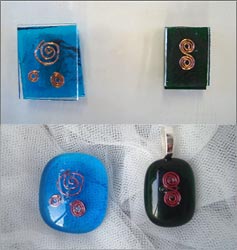
This is an early ‘before’ and ‘after’ glass experiment with wire, these were 2 of the ones that turned out OK!
My glass fusing pieces were very ‘hit and miss’, firstly they were mostly new experiments, they also had to survive being moved by car and then loaded into a kiln, and finally the ceramic kilns are big top-loader kilns with varying ‘hot and cold’ spots and unfortunately it resulted in mixed success.
I knew that if I wanted to take my glass fusing further I really needed to get my own kiln.
Thanks for joining me on my creative journey, more to follow…
Sam Rowena, jewellery artist
Why bother doing art and craft events? What motivates us – the artists and makers – to do them?
I think its much more interesting to purchase something handmade and be able to chat with the maker, instead of purchasing something mass-produced from the high street or on the internet. At events, you get to see my work displayed, chat with me about particular pieces that you like, and find out more about them. It makes it a much more personal purchase.
“I enjoy chatting to people about what I do and taking part in art and craft events.”
Winter Arts Market at St Georges Hall, Liverpool
Although the main motivation for taking part in events, is for the opportunity to promote, display, and sell my work, there are other reasons too…
Like most designer-makers, my work is quite insular, so an event is a great opportunity to meet and chat with people, both customers, and other artists/crafters. Over the years, it’s been lovely that a number of friendships have blossomed out of chatting with my neighbouring stallholders at events. If I get a chance, I also enjoy taking a quick look around the art and craft stalls, to see who’s there are and say hello. I love seeing how everyone displays their work, the innovative and creative ways of using their limited space.
One of the things I don’t do is ‘sell’. I don’t like pushy salespeople and think there is nothing worse than people being hassled to buy something when they are just having a day out and enjoying looking around an art and craft fair. So, my work has to sell itself and I just help it out.
“Its really a great confidence booster, when people like my work and compliment it, and even better when they like it enough to purchase it!”
one of my beaded brooches made at my Easter event
I prefer to be busy at an event, so if an event has quiet spells, I’ll do some making, either my abstract beaded wire brooches (as they are easy to ‘pick up and put down’) or wirework shapes. I’m happy then as I get in my own creative zone and time flies. Plus it has other advantages too, as visitors are usually intrigued with what I’m making, and its a good way of starting conversations.
At some events, I only have a 6ft table and my making tends to be more hidden from view, but at other events, such as the ‘Art in the Pen’, ‘Handmade in Lancashire and at my jewelart pop-up events I have a bigger area and my making becomes part of the display.
my making/leaflets table at Art in the Pen
Occasionally I take part in charity fundraisers, so my being there is also helping out a good cause.
A highlight for me is that I get to visit and enjoy the atmosphere of some amazing venues. These range from gorgeous gardens to interesting buildings rich in histories, such as St Georges Hall in Liverpool and Lytham Hall in Lancashire. There is a lovely buzz about these places when they are filled with amazing arts and crafts and the hubbub of people chatting, admiring the stalls, and making purchases.
Thanks for joining me on my creative journey, come along and visit me at one my events,
Sam Rowena, jewellery artist x
After all the preparation work is done and you’ve been successful and got a stall at some art and craft events you’ve applied for, then the real work begins… It’s not just about ‘the making’, there’s sorting out your stall display, designing and getting business cards/leaflets printed, buying your packaging etc.
On the day of the event, once you’ve arrived and found where your stall is, there’s the unloading and moving everything, before setting up your stall display.
at the Winter Arts Market St Georges Hall, Liverpool
“Ideally, if I’ve got time before the event opens to the public, I like to take a quick look around the venue and see who’s there and say hello to the other stallholders that I know, but sometimes it has to wait until quiet spells later on in the day.”
Art and Craft events are very ‘hit and miss’. There are many factors outside of your control…
The weather
Outdoor events are often a wash-out if its bad weather, raining and windy, not to mention the potential to damage your art and craft. But equally, in the summertime, if its lovely weather, people don’t want to be indoors visiting an event.
Footfall
If its a new event in a venue that doesn’t have a good footfall, it can often take a while for it to get established and attract visitors.
Too many similar types of stalls
Some events aren’t selective, they just want to fill the stalls. It’s better for an event to have a good variety of different work, to attract visitors to the event. “This happens all the time to me – with jewellery – and although its usually all different work, there are only so many people that are going to buy jewellery at an event.”
Hobby-makers and bought-in work This makes it really difficult for the artists and designer-makers who are trying to make a living from their art/craft as you can’t compete price-wise with the hobby-makers or work that’s been mass-produced in other countries. “I now mostly try to take part in art/craft events where there’s been a selection process involved.”
Stall location
If your stall is in a corner or your neighbouring stall has a card spinner or clothes rail in the space between the stalls, your stall can easily get blocked by people looking at their stall. “This is really frustrating and has happened to me at events many times. I usually give it a few minutes grace, and then if my stall is still being blocked I go out and ask them to move so that I can get to my stall display and tidy it up.”
The time of year
The run-up to Christmas is the best time of year, as many visitors are buying Christmas presents. At other times of the year, it depends on whether visitors have a reason to buy ie. birthday presents or see something they like and either want to treat themselves or are with someone else that wants to treat them.
rainy and windy day at the Liverpool One Arts Market
When an event doesn’t work out, it’s hard not to take it personally and think that people don’t like what you make.
Figure out why your work hasn’t sold at that particular event and if it’s one or more of the above factors, or if there might be things you can improve upon, ie. your display, range of pricing, negativity etc. You can use each event as a marketing opportunity to see what does sell, what are visitors interested in, what comments and feedback you get and use it to give out your leaflets and business cards. A visitor who is interested in your work, might not be ready to buy at this event, but might come to another event later on and buy from you then.
Its all part of the learning curve, you have to try out different events to find the ones that are right for your work.
If it’s not busy, it’s nice to get to know the artists, designer-makers and craftspeople on your neighbouring stalls, see what they make, chat about events, marketing etc and help each other out if you need to leave your stalls.
“Over the years, I’ve tried out many different types of events and some just don’t work for me… these include family fun days, school fairs and vintage (with a bit of handmade) events, so I leave these events for others to do.
“I hope this information is both interesting and helpful for other artists, designer-makers and craftspeople doing events and visitors to the events.”
Thanks for joining me on my creative journey,
Sam Rowena, jewellery artist x











 jewellery artist
You must be logged in to post a comment.